Great software starts with a clear vision, mission and objectives. The architecture should fit the product, the expected scale and the team that has to work with it.
Every technical choice creates an operational footprint.
When making architectural decisions, also consider:
- how much infrastructure you need to manage;
- how many components require operational attention;
- how much observability and troubleshooting are needed;
- how much deployment and release complexity you introduce;
- how much specialized knowledge is required to keep everything healthy.
Keep the change surface under control.
A good architecture keeps changes local and understandable. Adding or changing a feature should not put a large part of the system in motion every time.
The practical test is simple:
Can we still build, test and ship a feature efficiently?
When every change touches multiple services, pipelines, repositories, infrastructure components and contracts, the amount of work required to change the system safely keeps growing.
A small team can build a lot when the architecture gives it the right leverage.
Scale matters here as well.
Designing for a scale you will probably never need introduces unnecessary complexity. Ignoring future growth can cause just as many problems.
Good architecture is about making the right trade-offs.
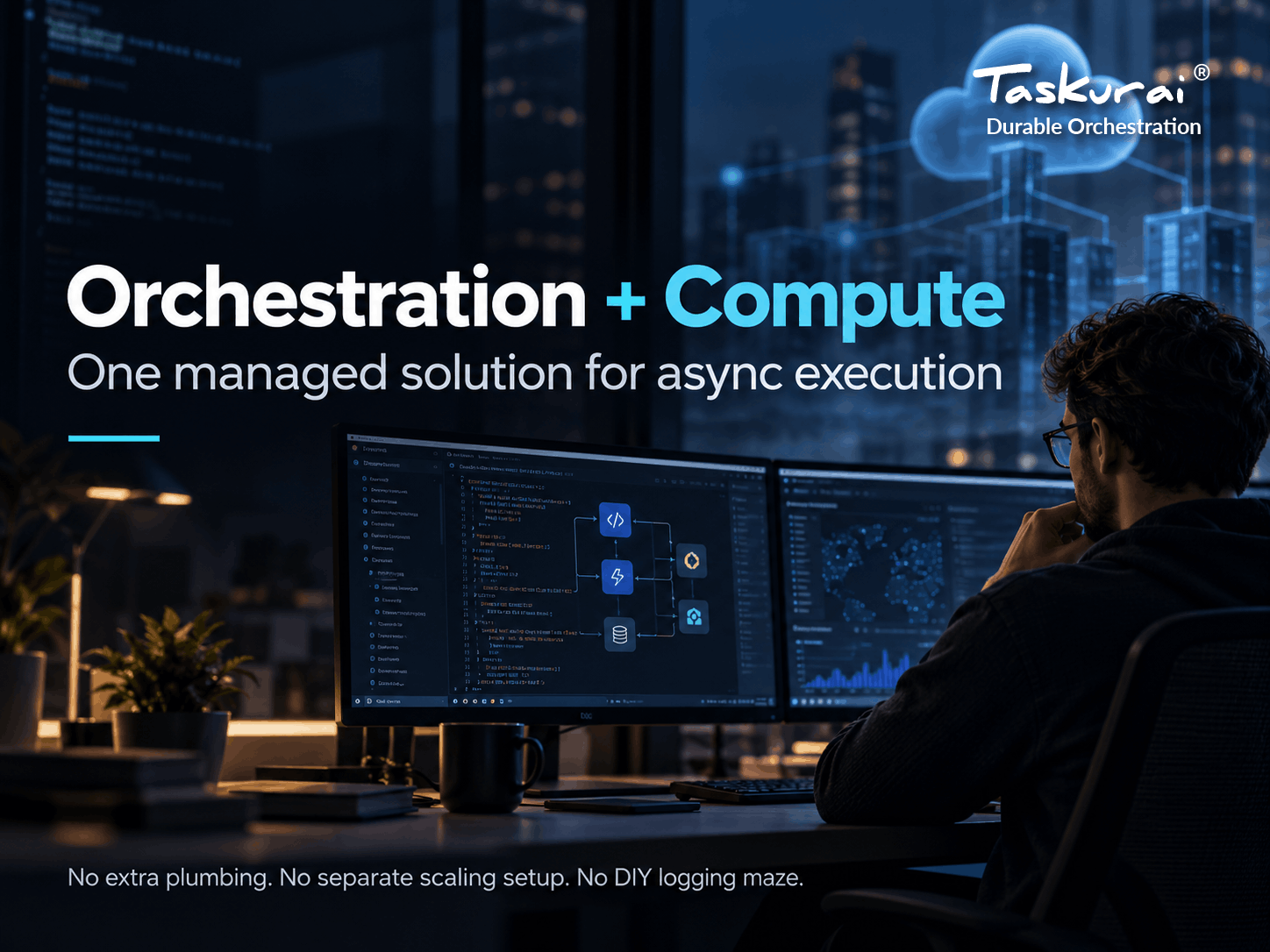
That is also why Taskurai focuses heavily on keeping both the operational surface and the change surface small.
Developers get a simple model for background and durable execution, without first having to assemble and maintain a complete execution stack themselves.
Taskurai takes much of the underlying complexity around execution, state, retries, scheduling, deployment and observability out of the day-to-day development work.
That allows a smaller team to stay focused on the features that actually differentiate the product.
Taskurai itself was built from the same conviction: with the right choices, abstractions and tooling, a small team can achieve a lot.