Orchestration solves only part of the async execution problem.
A durable workflow still needs somewhere to run. That introduces another layer of engineering decisions: workers, deployment, scaling, retries, execution state, logging, observability and operational control.
Teams can end up selecting an orchestration engine and then building a platform around it before the first business workload is production-ready.
Taskurai approaches the problem as one managed execution capability.
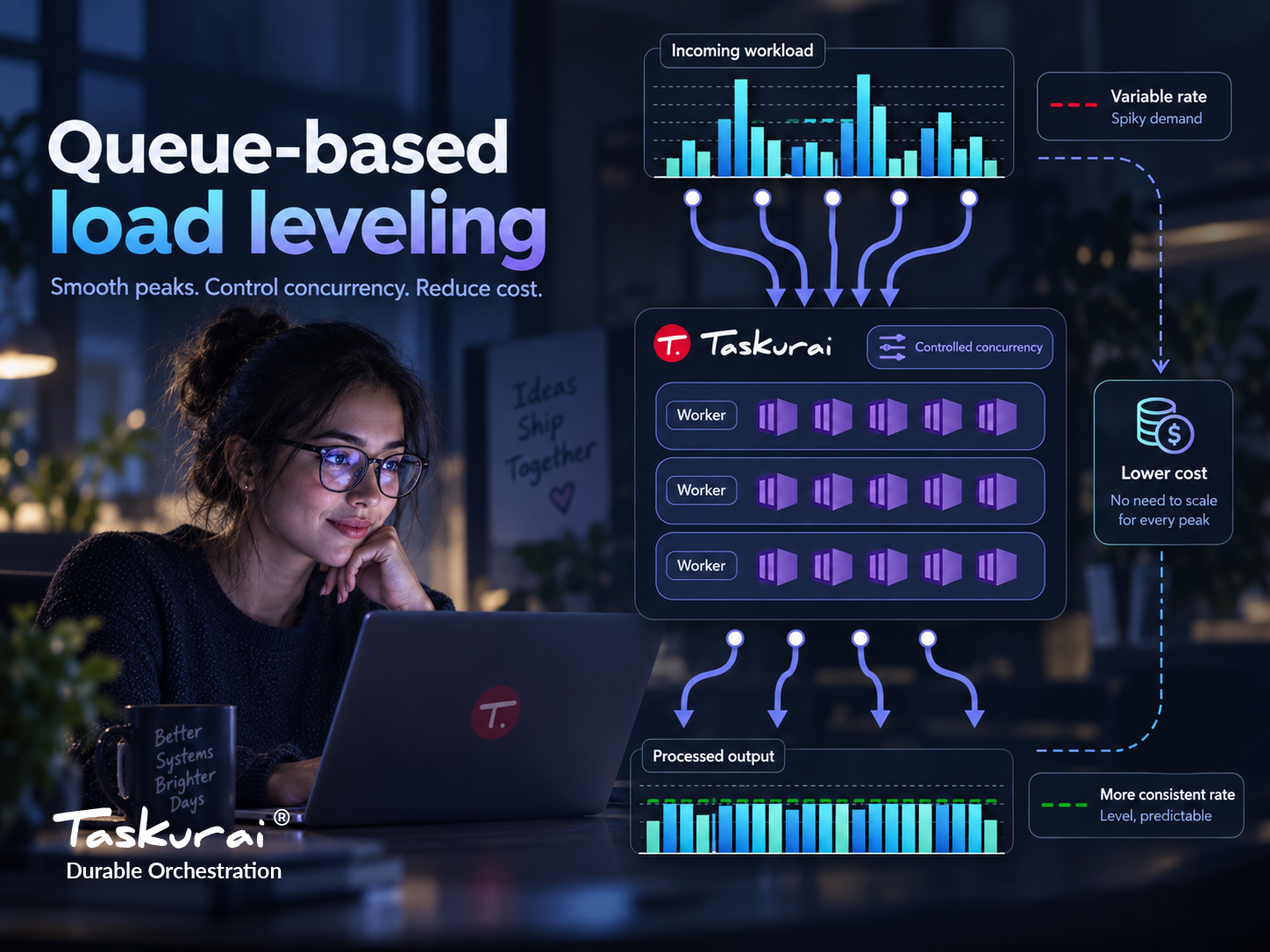
Applications define their workloads in code. Taskurai manages the execution lifecycle and can provision and scale the compute that runs those workloads.
The workers run as managed compute inside the customer's own Azure subscription, within the customer's existing network and security boundaries. This keeps the execution layer close to internal services and data while Taskurai manages the worker lifecycle and scaling.
The goal is not to replace an organization's complete application landscape. Existing APIs, databases, services, integrations and domain logic remain exactly where they belong.
Taskurai focuses on one bounded capability: reliable asynchronous execution.
That means teams do not need to assemble a separate worker platform around orchestration just to reach production. Scaling, execution state, retries and end-to-end observability become part of the same execution model.
This turns a recurring infrastructure project into a platform capability.
Custom software can remain custom where the business is unique, while the underlying execution infrastructure does not have to be rebuilt for every workload.